





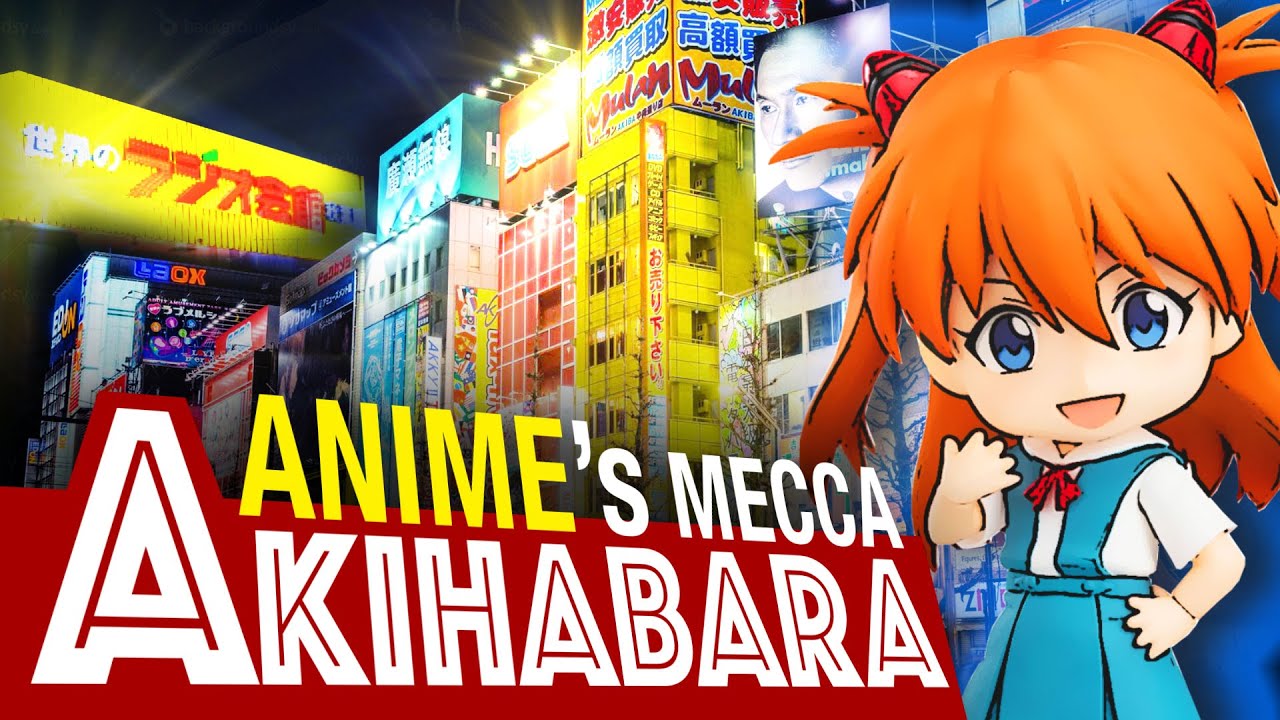
Welcome to the new series of this channel, “Tokyo Analysis”. This time, we feature Akihabara (秋葉原), the safe haven of Anime.
In 82 hectares, a comparatively small area known as Akihabara in Tokyo, which is less than a quarter of New York Central Park, a multitude of specialized stores for electronics and computers, as well as anime shops, are crammed together.
Imagine Diagon Alley from Harry Potter to get a sense of it. In this limited space, numerous street-front stores are densely packed, creating a bazaar-like atmosphere with a diverse and vibrant character. As you walk through, greeted by each store’s unique signs and products, you can sense the deep history and expanse of the city. This is a significant part of Akihabara’s charm.
This time, we’re going to analyze the origins of Akihabara, its evolution into an electronics district, and how it ultimately became a sanctuary for anime shops and the mecca of maid cafes. Lastly, we’re going to analyze the future projects of this unique city.
0:00 OP
01:05 Chapter 1: The Origin of Akihabara
04:58 Chapter 2: Akihabara The Town of Electronics
09:13 Chapter 3-1: Anime Shops in Akihabara
12:43 Chapter 3-2: Maid Cafe in Akihabara
15:22 Chapter 4: Problems with Akihabara
17:53 Chapter 5: Future of Akihabara
21:38 ED
82 hectares. In this comparatively small area known as Akihabara in Tokyo, which is less than a quarter of New York Central Park, a multitude of specialized stores for electronics and computers, as well as anime shops, are crammed together. Imagine Diagon Alley from Harry Potter to get a sense of it.
In this limited space, numerous street-front stores are densely packed, creating a bazaar-like atmosphere with a diverse and vibrant character. As you walk through, greeted by each store’s unique signs and products, you can sense the deep history and expanse of the city. This is a significant part of Akihabara’s charm.
Hi, I’m Atsu, the owner of this channel. In this video, we’re going to analyze the origins of Akihabara, its evolution into an electronics district, and how it ultimately became a sanctuary for anime shops and the mecca of maid cafes. Lastly, we’re going to analyze the future projects of this unique city.
Welcome to the enchanting city of Akihabara. The history of the Akihabara area in Tokyo starts from around 1600 and was once part of Edo, the old name for Tokyo. During this era, the samurai government, Tokugawa Shogunate relocated its base here, initiating significant land development in the current Tokyo area.
Located merely 3km from Edo Castle, the region alongside the Kanda River became populated with merchants and the residences of shogunate officials. A major issue in Edo was the frequent occurrence of large-scale fires, primarily due to the density of the wooden houses.
This remained a challenge even into the Meiji period, the era of modernization. On January 13, 1870, a devastating fire in the area of present-day Akihabara destroyed around 1,100 households. In response, a large open space was created to hinder fire spread,
And a shrine was built to honour three gods of fire suppression. However, due to existing local beliefs in Akiba Gongen, the god of fire, the area was mistakenly associated with this deity and gradually became known as ‘Akihabara.’
In 1890, with the extension of the railway to this region and the establishment of Akihabara station, the area experienced further development. The electrification of the railway in 1925 significantly boosted passenger transport, transforming Akihabara into a transportation hub. During this period, a huge fruit and vegetable market was opened near Akihabara Station.
Alongside this, an elevated freight platform was built, facilitating cargo transfer to lorries via chutes. This railway yard, a rarity in the world, was used until 1975 when the majority of its transportation share shifted to road transport. The landscape of Akihabara took a pivotal turn in 1933 when Hirose Commerce Company,
Mainly focusing on the wholesaler of radio parts, set up shop in the area. This establishment marked the beginning of Akihabara’s transformation into an electronics district. Around this time, in the 1930s, when there was no television yet,
the radio penetration rate in Japan reached as high as 85%, and the sales of related products generated significant profits. The area suffered heavily during the Pacific War, especially in the Tokyo air raids of 1945. But despite that, it rapidly rebounded post-war as electronics stores proliferated,
Forging Akihabara’s identity as a vibrant electronics hub. There were two key factors behind this phenomenon. Firstly, the major wholesaler: Hirose Commerce Company, attracted small retailers nationwide due to its comprehensive regional network, helping Akihabara gain a reputation for affordability and diversity. Secondly, the rising number of street vendors for radio parts,
Gathered from near and far, to the southwest side of the Akihabara area. As Tokyo’s recovery progressed, the need for organized town planning in the city grew. In 1949, to regulate and modernize, the GHQ(U.S. Armed Forces in Japan) mandated the relocation of those street vendors.
Tokyo Metropolitan Government, in collaboration with Japan National Railways, allocated space under the Akihabara Station overpass as an alternative site. This led to the establishment of the ‘Radio Store’ under the overpass, initiating the transformation of this area into a lively, bazaar-like electronics market.
By 1950, with the opening of ‘Radio Center’ and ‘Tokyo Radio Department Store’, the area solidified its identity as a bustling hub for electronic goods. This evolution laid the groundwork for modern Akihabara, now synonymous with electronics and technology, centred around Akihabara Station. While younger generations might predominantly associate Akihabara with anime,
It has actually been known since the post-war period as a hub for electronic and computer goods among many Japanese people. For instance, a survey conducted among residents in the Tokyo area revealed that more people viewed Akihabara as an electronics district than as a hub for anime.
In this part, we will unravel how Akihabara evolved into an electronics district before it became known as a mecca for anime. The 1959 royal wedding of Crown Prince Akihito and the consumerism of the post-war baby boom era notably hastened TV adoption in households.
Television ownership, including colour TVs, jumped from 8% in 1965 to 73% by 1975. This television boom also propelled the home appliance market forward. Japanese homes increasingly featured stereos, cassette recorders, refrigerators, and air conditioners, thanks to mass production in the appliance industry that lowered prices and increased consumer demand. The retail landscape also evolved.
Supermarkets in Japan expanded in size and number, influenced by American chain store concepts. In Akihabara, the 1962 construction of the ‘Radio Kaikan’ marked the town as a notable landmark for the home appliance market. By the 1970s, Akihabara grew to become Japan’s largest electronics town,
Accounting for 10% of the nation’s home appliance market in an area of less than 1 square kilometre. The town’s development persisted into the 1970s and beyond, even amidst challenges like the oil shock. Around this time, following other Tokyo areas, Akihabara introduced ‘a pedestrian paradise’ in 1973,
Transforming the central street into a pedestrian-only zone on Sundays. Post-1965, the ‘Made in Japan’ label became synonymous with quality, turning Akihabara into a favoured spot for international shoppers, with an increase in duty-free stores meeting this new demand. Consequently, Akihabara gained significant global recognition.
In the 1980s however, Akihabara faced challenges because of the rise of suburban electronics retail chains like ‘Kojima’ and discount stores. These competitors not only offered services like free parking but also took advantage of delivery systems making customers shop conveniently at distant stores.
A significant blow came in 1993 when Akihabara’s iconic ‘Shintoku’ electronics store closed. However, the town was on the cusp of another transformation. The personal computer revolution began to reshape the district. With the release of Apple’s Macintosh in 1984 and Microsoft’s Windows 3.0 in 1990, Akihabara shifted its focus to computer-related products.
Key players like ‘T-ZONE,’ ‘Laox The Computer Kan,’ and ‘Sofmap’ emerged, catering to the growing demand for computer technologies. The establishment of Japan’s first commercial Internet Service Provider, (Internet Initiative Japan) IIJ, in 1992 further boosted PC sales. By 1994, computer-related sales in Akihabara surpassed those of traditional electronics.
And here comes the pivotal moment of the town that occurred in 1995: the release of Windows 95. This new operating system, offering full-colour display capabilities and the first internet connectivity features, drew immense attention. On its release day, over 5,000 enthusiasts flocked to Akihabara,
With the aforementioned three PC stores offering this software at significantly discounted prices. Now, here’s the main takeaway. This Windows 95 release in Akihabara marked two major shifts. First, it established Akihabara as a ‘PC town’. Second, it changed its clientele from families seeking electronics to young male PC enthusiasts.
This shift drew fans from afar, altering the area’s demographic. These ‘otaku’ customers, interested in not only computers, but also anime, games, and figures, now became predominant in Akihabara’s market, making the town a centre for pop culture products. Now, we finally made it to this point. It’s time to delve into what you’ve expected:
How Akihabara became known as the epicentre of Anime culture. Once famous for radios, electronics, and computers, this chapter explores why this place transformed into a sanctuary for anime in modern Japan. Let’s first look back at the trajectory of Japan’s anime boom until the late 1990s.
In terms of the genre commonly known as ‘Bishōjo Anime’, or ‘beautiful girl anime,’ the character Maetel from ‘Galaxy Express 999’ is often cited as an early example, though this is controversial for some fans. Maetel, a female character who travels with the young Hoshino Tetsuro on the galaxy-crossing train 999,
Serves as his guide and provides emotional support for the boy journeying through a world filled with despair. She, with her blonde hair, mysterious aura, and beauty, became a beacon of hope for many male fans in dire situations, laying the foundation for the concept of ‘beautiful girl anime’.
Entering the 1990s, this trend became more pronounced with ‘Neon Genesis Evangelion.’ Characters like Asuka and Rei, fighting girls tasked with humanity’s survival against the “Angels”, juxtaposed with the protagonist Ikari Shinji(碇シンジ)’s introversion and aversion to social connections.
‘Evangelion’ gained immense popularity, peaking with its 1997 movie release, influencing the plastic model industry and subculture boom, and generating about 30 billion yen in economic impact, equals to two hundred fifty million US dollars. This phenomenon signified the success of “Beautiful Girl Anime” as a lucrative business. Turning to Akihabara’s evolution,
The rise in interest among some computer enthusiasts, in anime, games, and plastic models or figures solidified its status as a hub for subculture. Those fans were eventually referred to as “Otaku” in a lot of media. This foundation was further strengthened by the ‘Evangelion’ craze, significantly altering Akihabara’s landscape.
A prime example is the ‘Radio Kaikan’ building. Until 1998, Radio Kaikan primarily dealt with electronics and computers, but from March that year, its floor composition rapidly changed. Computer stores were replaced by hobby shops like ‘Kaiyodo,’ ‘Yellow Submarine,’ and ‘Hobby Station,’ which occupied about half the space by the end of 2000.
The transformation of Akihabara’s central street (Chuo Dori) was also remarkable; what was predominantly electronics stores in 1995 had completely changed into anime merchandise shops by 2006. Let me introduce ‘Animate Akihabara,’ a flagship anime store in the town.
Opened in 1997, and situated away from Akihabara’s central street, it dealt with anime products, CDs, DVDs, comics, and magazines. Responding to growing demand, it relocated to a main street-facing 8-story building in April 2001. A 2009 expansion merged it with an adjacent building.
By 2022, it had grown significantly, opening a second building on the same street. Other anime shops like ‘Kotobukiya,’ ‘Surugaya,’ and ‘Volks’ also contribute to Akihabara’s status as a sacred place for anime. So, that’s the overall analysis of anime-related stores in Akihabara.
However, there is another important genre that is indispensable in describing this town. Maid café. The origins of maid cafes are rooted in the ‘beautiful girl characters beloved by otaku’ which I mentioned earlier. In the 1990s, not only combat-oriented beautiful girl characters like Asuka and Rei were popular,
But also those retaining a youthful appearance. This trend was particularly noticeable in the gaming world, with characters like Fujisaki Shiori from ‘Tokimeki Memorial’ and Sakuragi Mai from ‘Dōkyūsei’ being prime examples. As part of their promotion, game companies began to hold cosplay events that recreated the worlds of their games.
By the late 1990s, with corporate backing, cosplay cafes related to games and anime started appearing throughout Tokyo. In this context, a temporary, time-limited cafe was opened at a Tokyo game event in 1998, where staff dressed in costumes of characters from the game ‘Pia❤️Carrot e Youkoso!!’. …I hope I’m pronouncing correctly.
Then, in March 2001, the world’s first permanent maid cafe, ‘Cure Maid Café,’ opened in Akihabara. Known as a pioneer of maid cafes, this store didn’t emphasize the familiar and adorable service found in other maid cafes, except for the waitresses wearing maid outfits, making it quite similar to a regular cafe in Japan.
In 2002, ‘Cafe Mai:lish’ further evolved the maid cafe concept. It became famous for waitresses in anime-style maid outfits welcoming customers with… ‘Welcome home, Master and Mistress!’, a now typical maid cafe greeting. However, ‘M’s Melody’, established in Nagoya in 2002, might have been the first to adopt this style. ‘Cafe Mai:lish’ was initially managed by the aforementioned ‘T Zone’, the computer store known for selling Windows 95.
Facing declining sales, ‘T Zone’ shifted to the amusement business, incorporating insights from ‘Cure Maid Café’ the pioneer of the genre into ‘Cafe Mai:lish’. The cafe adopted a day-night system with different themes like ‘Gothic Day’ and ‘Cat Ear Day’, becoming a symbol of Akihabara’s otaku culture.
This innovation helped maid cafes rapidly emerge as a new business model in Akihabara. The popularity was further boosted by ‘Densha Otoko’, a romance novel set in Akihabara, featuring a maid cafe as a key location. By 2023, Akihabara had about 50 maid cafes, showcasing the enduring appeal and growth of this unique business model.
We have so far highlighted the glorious history of Akihabara, but it’s also important to acknowledge that there are also darker aspects. A significant negative side of Akihabara is the ‘Akihabara Mass Sta**ing Incident.’ On June 8, 2008, around noon, a man ran over pedestrians by a lorry on the pedestrian paradise of the town.
Before he got arrested, the man sta**ed several people, resulting in seven deaths. I will skip the details to avoid censorship, but this incident led to Akihabara’s pedestrian paradise being closed for nearly three years and tarnishing the town’s name. Rest in peace for the lives of the victims.
Now, this part analyzes the two major social issues this town confronts. Firstly, since 2020, Akihabara has faced economic and cultural challenges, especially among anime shops struggling to survive. There are several issues including limited parking spaces for tourist buses, but the biggest problem is the surge in online shopping.
This, in particular, diminishes Akihabara’s once-exclusive allure of physical subculture shops. For instance, ‘Toranoana,’ a manga bookstore, witnessed a doubling of online orders from 2019 to 2022, while foot traffic in stores plateaued, prompting the closure of five outlets, including the original Akihabara store. Post-COVID movement restrictions exacerbated these struggles.
Another serious concern is the disruption caused by… Um, again, for the sake of censorship, let’s say the growth of “industry for naughty boys”. If you know it, then you know it. As the anime market expanded, so did content for “naughty boys” distribution,
Leading to the emergence of similar stores in vacant spaces, causing distress to local businesses. Additionally, some maid cafes, offering this kind of service and opening basically at night, further strain the community by using aggressive solicitation tactics and overcharging. Historically, Akihabara was a vibrant electronics hub with a strong, family-oriented local community.
The influx of clandestine “naughty boys” entertainment ventures now threatens its future. Overall, Akihabara stands at a crucial economic and cultural crossroads. The rise of online commerce challenges anime shops, while the proliferation of “naughty boys” entertainment venues tarnishes its image and economic health.
The district risks losing the robust community ties and family-friendly atmosphere that once defined it. To address the concerns, especially related to its “industry for naughty boys”, the redevelopment of Akihabara is seen as a pivotal solution. In this part, we will introduce Akihabara’s main redevelopment plans and people’s reactions towards that project.
Initiated in 2001 under the leadership of then-governor Shintaro Ishihara, this redevelopment is Tokyo’s last major project of its kind. The plan involved a 16,000-square-meter area near Akihabara Station, formerly occupied by the aforementioned railway yard and a produce market.
The whole place was closed by 1989 and was designated for the construction of a large complex of buildings. At that time, the southern half of this area was temporarily used as a basketball court, a memory familiar to many. A key development in this project was the 2006 inauguration of ‘Akihabara Crossfield,’
A complex of two buildings aimed at establishing a global IT hub, drawing on Akihabara’s appeal as the ‘Town of Electronics.’ This development coincided with the opening of the Tsukuba Express in 2005, the newest railway in Tokyo.
It elevated Akihabara to a major transport hub in Tokyo, leading to increased office demand in the redeveloped areas. The next phase of redevelopment targets a 1.7-hectare area in front of Akihabara Station, known for its electronics stores and a mix of restaurants, Anime stores, and maid cafes.
The plan is to demolish existing structures to construct a high-rise, up to 170 meters, for offices and commercial spaces, along with a hotel catering to tourists. Additionally, a waterfront park along the Kanda River is proposed to enhance the area’s appeal.
This redevelopment has been a topic of debate for about two decades, with opinions among landowners divided. Proponents emphasize the need for newer, earthquake-resistant buildings, while opponents fear the loss of Akihabara’s historical and cultural charm with the demolition of old post-war structures. Regarding the redevelopment project, there are several opinions from experts.
Toshimichi Ikeda (池田利道), head of the Tokyo 23 Wards Research Institute, criticizes the prevalent ‘scrap-and-build’ approach in Japan, which he believes often erases the unique character of cities. He notes that the ‘Akihabara Crossfield, is significantly altering the area’s landscape, affecting even the surrounding neighbourhoods.
This redevelopment has led to the disappearance of many local stores and caused unease among businesses outside the redevelopment zone. Ikeda highlights that rising land and rental prices in Akihabara, a district once known for affordable electronic goods, pose a significant challenge to maintaining low-cost offerings.
Meanwhile, Professor Seo, who contributed to the Akihabara Crossfield project, offers a different perspective. He advises not to completely dismiss redevelopment, pointing out the role of modern constructions like Akihabara Crossfield in making the city more welcoming for families. However, he cautions that excessive development could deter visitors.
He emphasizes the need for balance, suggesting that Akihabara’s evolution, powered by the creativity of its residents and Anime culture, requires careful external guidance. Overall, Akihabara’s redevelopment presents both opportunities and risks. It can foster urban growth and attract new interest but also threatens to erase the area’s historical and cultural identity.
The insights from two experts suggest a need for redevelopment strategies that respect the district’s heritage while integrating new values, requiring close collaboration among local stakeholders and thoughtful, inclusive planning. And that’s the story of Akihabara. I honestly like this unique town, not simply because of the anime shops and maid cafes
But because it has a unique style of bazaar-like atmosphere of the good old days of Japan. Now, here’s the recap of this video. From a leading electronics marketplace post-World War II, it became synonymous with Japan’s anime culture. However, challenges like the rise of online shopping, the proliferation of … well, “naughty boys” entertainment,
And the impacts of COVID-19 have raised concerns about preserving its community ties and family-friendly character. The ongoing redevelopment, including projects like Akihabara Crossfield and new high-rises, aims to modernize the area while sparking debate about balancing historical charm with urban development needs.
Akihabara’s future hinges on maintaining its unique culture, while adapting to changing societal trends.
insane production quality dude, glad i gave the video a chance 😊
Keep it up!
Commenting for engagement because this channel deserves more attention 🙂